Vintage Sub-Zero · model 532
Sub-Zero 532 Repair
The 30-inch over-under that fit the galley kitchens a wider box never could. Narrow, tough, and almost always worth rebuilding.
The Sub-Zero® 532 — the 30-inch over-under built-in of the 1990s 500 series — usually fails at the defrost circuit, the cold control, or, in time, the evaporator. Our Ortega bench rebuilds 532s across Avondale and Riverside; a new evaporator and heat exchanger runs about $2,500, against roughly $14,000 to replace the machine.
For vintage Sub-Zero repair in Ortega, Avondale, and Riverside, call the shop at (904) 893-3248 or Book online .
Sub-Zero Repair Ortega repairs the Sub-Zero 532 for Ortega, Avondale, and Riverside — ZIP 32210 — on a diagnose-first basis. Reach the bench at (904) 893-3248, Tuesday through Saturday, or arrange a visit through our external online booking page.
Updated June 13, 2026.
(904) 893-3248 · Tue–Sat · 8:00 am–6:00 pm · you reach the bench, not a call center
The 532 in the Ortega lineup
The 532 is the narrow member of the over-under family. Where the 36-inch 550 claimed the larger remodeled kitchens, the 30-inch 532 went into the tighter cabinet openings of Ortega and Riverside bungalows — the galley runs where every inch of counter mattered. Decades on, it is still doing that job, tucked behind panel fronts matched to millwork no one could reproduce today.
Because the 532 shares so much with the rest of the 500 series, its faults are familiar: a defrost circuit that ices up, a cold control that drifts off its set point, fan motors with dried bushings, and gaskets hardened early by river humidity. The one repair that defines the 532 in our shop, though, is the sealed-system rebuild — and that is where the repair-or-replace math comes down hardest in the owner’s favor.
The 532 repair-or-replace arithmetic
No other model lays the economics out as cleanly as the 532, which is why owners across Avondale and Ortega Forest end up keeping theirs. Here is the side-by-side we walk through before any sealed-system work starts.
| Path | What it includes | Approximate cost |
|---|---|---|
| Rebuild the 532 sealed system | New evaporator, heat exchanger, recovery, vacuum, recharge | About $2,500 |
| Replace with a new built-in | New 30-inch unit, delivery, install, cabinetry alterations | Roughly $14,000 |
| Minor 532 work | Cold control, fan motor, defrost, gasket | $550–$1,100 |
| Airflow / coil service | Condenser cleaning, fan check | $250–$550 |
The deep work itself lives on our sealed-system page; the broader logic of what is worth saving is in the preservation shop notes.
How the 532 fails, in order of likelihood
A 532 call follows the same sequence whatever the complaint, because the cheap faults sit ahead of the expensive ones in the order of checks.
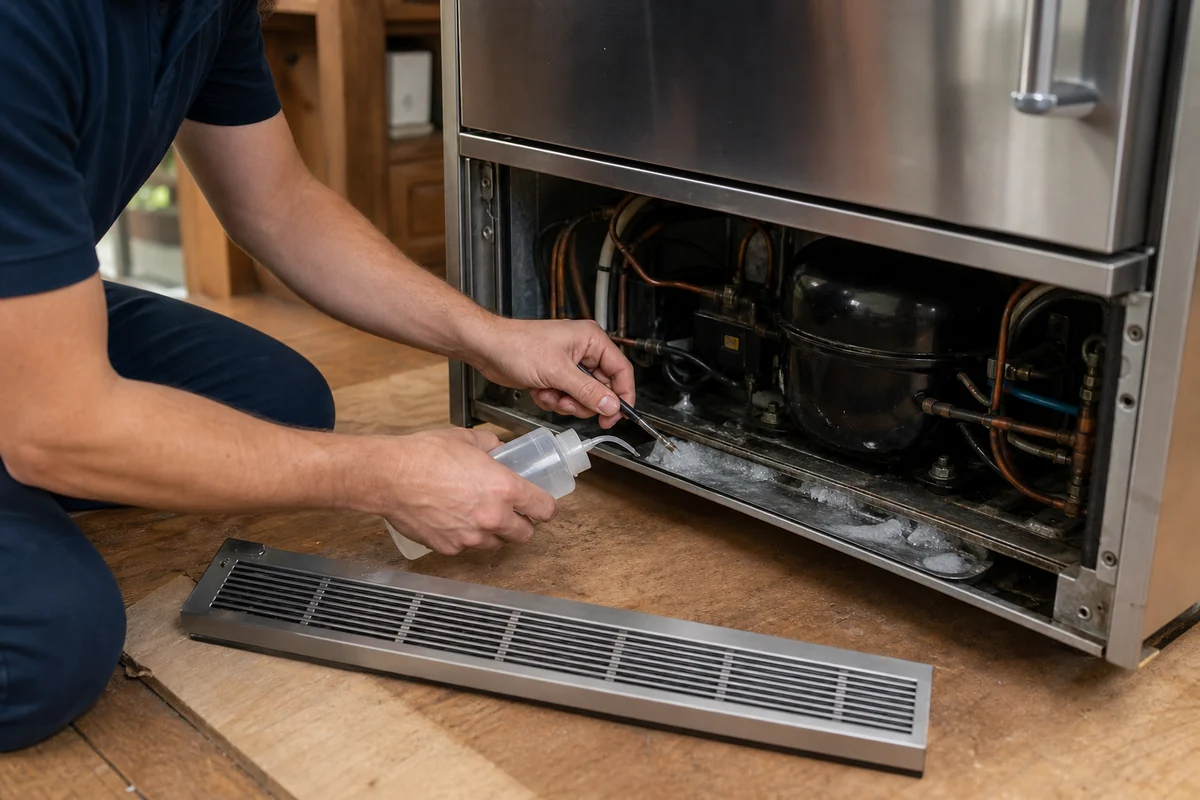
- Pull the lower grille. The condenser coil and condenser fan come first — riverfront dust and oak pollen load them faster than the design ever assumed.
- Check the defrost circuit. On an over-under with heavy freezer ice, the defrost heater, termination thermostat, and drain are the prime suspects.
- Read the controls. Cold control calibration and thermistor resistance tell us whether the box is being asked for the right temperature.
- Test the fans. A stalled evaporator fan warms the fresh-food side on its own; both motors get a power and bushing check.
- Read the frost last. A full, even coat sends us back to the shallow faults; a short partial stripe is the evaporator leak and the sealed-system conversation.
532 parts, year range, and what we keep on the shelf
The 532 ran as a single mechanical generation through the 1990s, which keeps parts simple: no electronic-generation splits, and the pieces it needs are still made or easily cross-referenced. These are the components we stock for it.
| Part | What it fixes | Repair lane |
|---|---|---|
| Cold control / thermostat | Set point drift, food freezing or warming | $550–$1,100 |
| Defrost heater & termination thermostat | Heavy localized freezer ice | $550–$1,100 |
| Evaporator & condenser fan motors | Warm fridge, new rattle or buzz | $250–$1,100 |
| Door gasket kit | Sweating, longer run times, edge frost | $550–$1,100 |
| Evaporator & heat exchanger | True sealed-system leak | About $2,500 |
Gasket rubber and ice-side scale are the 532’s two most common non-cooling complaints — see gasket replacement and ice maker service for the details on each.
Sub-Zero 532 questions
What is the difference between the Sub-Zero 532 and the 550?
Both are over-under built-ins from the same 500-series era, but the 532 is the 30-inch-wide cabinet and the 550 is the 36-inch. The narrower 532 turns up in the galley kitchens of Ortega and Riverside bungalows where a wider box never fit. Mechanically they are close cousins — defrost, cold control, and fan faults dominate both — so the diagnosis runs the same order. The 532 just trades a few inches of shelf for a footprint that slots into a tighter cabinet opening.
My 532 needs a new evaporator — is it worth the money?
Usually, yes, and the 532 is the unit that makes the case most plainly. A 1990s 532 takes a new evaporator and heat exchanger for about $2,500, against roughly $14,000 to buy and install a modern 30-inch built-in and alter the cabinetry to fit it. For a machine sitting behind original 1920s panel fronts in Ortega or Avondale, the rebuild is the rational choice nine times in ten. We lay out that math, in writing, before any work begins.
How much does a typical 532 repair cost?
Condenser cleaning and airflow work land at $250 to $550. A cold control, an evaporator fan motor, a defrost-drain clearing, or a gasket kit runs $550 to $1,100. The big one — a sealed-system rebuild with a new evaporator and heat exchanger — is around $2,500, inside the $1,500-to-$3,000 lane. You get a firm written figure after diagnosis, never a phone estimate.
The freezer side of my 532 frosts up heavily. What causes that?
Heavy, uneven freezer frost on a 532 usually points to a defrost fault — a tired defrost heater, a failed defrost termination thermostat, or a drain that has iced shut — rather than a refrigerant problem. We read the frost pattern and check the defrost circuit before anyone mentions the sealed system, because a defrost part is a far cheaper fix than an evaporator. Even, light frost is normal; a thick localized ice ball is the tell.
Can you still get parts for a Sub-Zero 532?
For the great majority of 532 jobs, yes. Cold controls, defrost components, fan motors, relays, door gaskets, and compatible compressors are still obtainable or easily cross-referenced for the 500 series, and we keep the common pieces on the Ortega shelf. The 532 ran a single mechanical generation, so there are no electronic-board scarcity surprises like the later 600 series can bring.
My 532 runs constantly and the kitchen feels warm near it. Is the compressor dying?
Rarely the first cause. A 532 that never cycles off is most often fighting a blanketed condenser coil — Ortega oak pollen and dust choke airflow faster than the manual expects — or a slow refrigerant leak. We pull the lower grille, inspect and clean the coil, read amp draw and pressures, and only then talk about the compressor. See our note on a Sub-Zero that runs constantly for the full walk-through.
Bring us the machine everyone else gave up on.
The shop answers Tuesday through Saturday, eight to six. One visit, a straight diagnosis, and a firm number before any work begins.