Diagnosis notes · updated June 13, 2026
Sub-Zero Loud Buzzing, Humming, or Clicking Noise in Ortega
A noise is the easiest fault to ignore and the most expensive one to misread. A Sub-Zero® that buzzes, ticks, or clicks is not one problem — it is three or four different ones wearing the same costume, and each lives in a different cost lane.
A buzzing, humming, or clicking Sub-Zero almost always traces to one of three sources: a fan blade ticking against frost or running on a dry bearing, a hard-start relay clicking as it tries to launch the compressor, or an ice-maker fill valve straining against Jacksonville’s hard water. In Ortega and Avondale we isolate which one before quoting — fans and valves run $250 to $550, relays $550 to $1,100, a knocking compressor $1,000 to $2,000.
For vintage Sub-Zero repair in Ortega, Avondale, and Riverside, call the shop at (904) 893-3248 or Book online .
(904) 893-3248 · Tue–Sat · 8:00 am–6:00 pm · you reach the bench, not a call center
Three places the sound is coming from
The mistake we hear most over the phone is treating “loud Sub-Zero” as a single complaint. It never is. The cabinet holds two fans, a compressor and its electrical pack, and an ice maker that cycles water on its own schedule — and any of them can be the voice you are hearing. Before we name a part, we name the source:
- A fan blade ticking frost or running dry. Both the evaporator fan inside the cabinet and the condenser fan down by the compressor can clip a ridge of ice or grind on a dried-out bushing. On 500 and 600 series machines this is the single most common noise call, and it lives in the cheapest lane.
- A hard-start relay or overload clicking. When the compressor cannot launch cleanly, the start relay tries again and again — a rapid click–pause–click without the unit settling into a run. That is an electrical part begging for attention, and catching it early can spare the compressor behind it.
- An ice-maker fill valve fighting hard water. JEA water here runs 14 to 28 grains per gallon, so scale builds inside the fill valve until it buzzes or chatters during the fill cycle. The noise comes a few times an hour and often pairs with thin or hollow cubes — the signature of a valve working too hard.
A fourth source is the one we work hardest to rule in or out: the compressor itself. A compressor with worn internal bearings can knock or rattle, but that is the costly diagnosis, so we never reach for it until the fans, the relay, and the valve have all been cleared. Naming the compressor first is how owners get oversold; naming it last is how this shop keeps invoices honest.
Cause, evidence, and cost band
Every noise has a tell — a pitch, a timing, or a test you can run before we arrive. The table below maps the sound you hear to the evidence that confirms it and the lane it falls into, using the same planning ranges we quote across Ortega, Avondale, and Riverside.
| Sound & behavior | Likely cause & evidence | Cost lane |
|---|---|---|
| Rhythmic tick or buzz that stops when the door opens | Evaporator fan clipping frost or on a dry bushing — cabinet airflow drops, freezer slowly warms | $250–$550 — fan blade or motor |
| Low buzz or rattle from down behind the lower grille | Condenser fan bearing dried out — whole unit overheats, may run nonstop | $250–$550 — fan motor, coil clean |
| Rapid click–pause–click, no steady run | Start relay or overload failing to launch the compressor | $550–$1,100 — relay / overload |
| Buzz or chatter a few times an hour, thin cubes | Ice-maker fill valve scaled by 14–28 gpg hard water | $250–$550 — valve service |
| Deep knock or metallic rattle that runs with the compressor | Compressor internal bearing wear — confirmed by amp draw and pressure, never by ear alone | $1,000–$2,000 — compressor |
Notice that three of those five lanes are the inexpensive ones. That is not luck — it is what an honest diagnosis usually finds, because fans and valves wear far more often than compressors fail. The order we work the call is built to keep you in those lanes whenever the evidence allows.
The diagnostic sequence, cheapest cause first
A noise call rewards patience, because the sound itself is the evidence. We work it the same way every time, isolating the source before we ever reach for a part — and the cheapest causes get ruled in or out first:
- Open the door and listen. If the buzz or tick stops the instant the door opens and returns when it shuts, the evaporator fan is the source — the door switch cut its power. That one move can close a call in the $250 to $550 lane.
- Pull the lower grille and feel the condenser fan. A blade that wobbles or a bushing that resists turning by hand is a dry bearing imitating a far worse problem. Under the Ortega oaks the same grille often hides a felted coil, so we read both at once.
- Watch the start sequence at the relay. If the unit clicks rapidly without launching, we test the start relay and overload before anyone says the word compressor. A failed relay is a $550 to $1,100 part; a misdiagnosed one costs ten times that.
- Time the noise against the ice-maker cycle. A buzz that arrives with the fill and quits when the cubes drop is the valve, not the machine — and hard-water scale is the usual reason.
- Only then read amp draw and pressure. A true compressor knock shows up in the numbers, not just the ear. We confirm it with instruments and a firm written quote before any sealed-system work begins.
Four of those five steps cost nothing in parts. That sequence is exactly why most noise calls in Ortega and Avondale settle in the fan or valve lane rather than the compressor band — and why we will not name an expensive part until the cheap ones are honestly cleared.
How the bench separates fan from relay from compressor
The whole craft of a noise call is refusing to guess. We isolate the source mechanically and electrically: the evaporator cover comes off to check the inner fan for frost contact, the lower grille comes out to inspect the condenser fan and coil, and a clamp meter reads the compressor’s start and run current against the nameplate. A relay that is failing announces itself in the start current; a worn compressor announces itself in the run current and the head pressure.
Only when the numbers point at the sealed system do we treat the noise as a compressor matter, and only after you hold a firm quote for the sealed-system repair. Everything shallower — fans, relays, the ice-maker valve — falls under ordinary refrigerator service and is usually finished the same visit. If the noise is purely the ice maker, our ice-maker repair notes walk through the hard-water side in full.
The Ortega pattern: oaks, river air, and old wiring
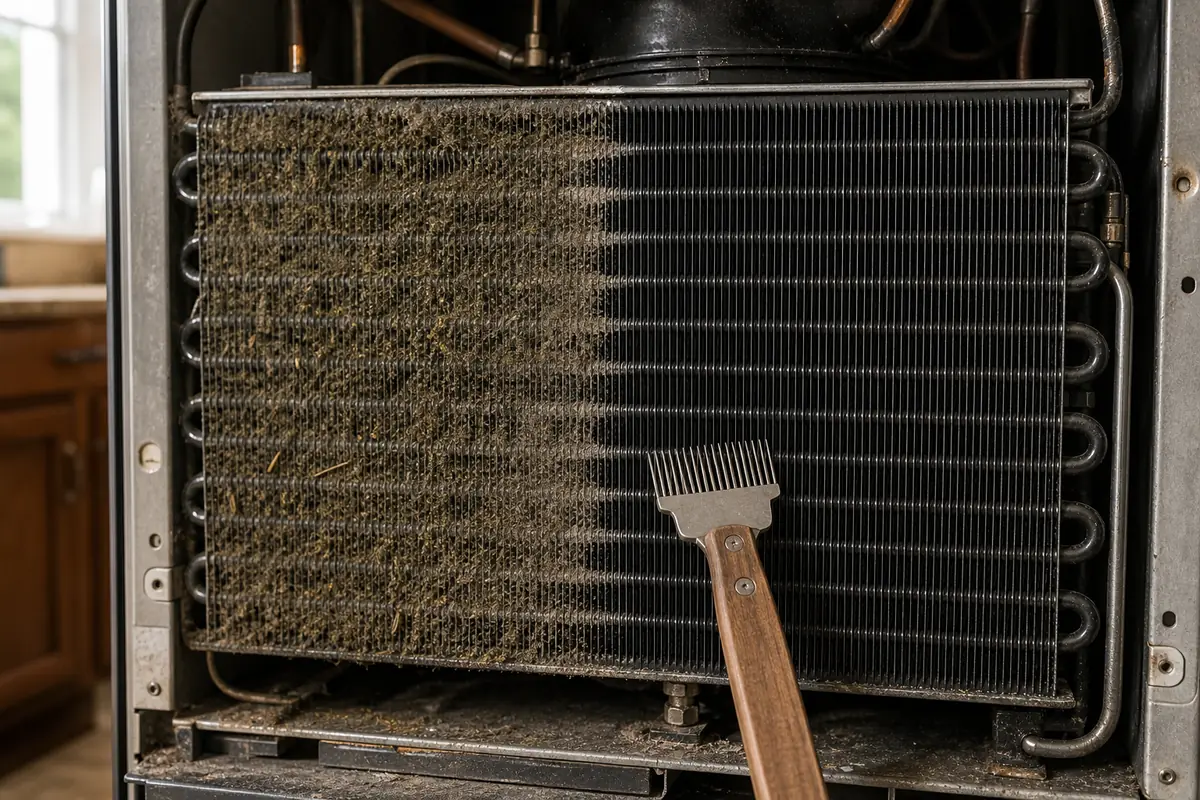
Our neighborhood shapes which noises we hear most. The oak canopy over Ortega Boulevard and McGirts drops pollen and debris that mat the condenser, and a coil-blanketed unit runs hotter and longer — which is when a marginal fan bearing finally starts to sing. River air keeps gaskets and bushings damp, aging the soft parts ahead of schedule. And the original electrical panels behind 1920s and 1930s plaster pass every storm surge straight to the start relay and the control board.
That last one matters more than owners expect. When power returns after one of Northeast Florida’s frequent outages, the restoration surge can run well over nominal voltage for a moment — long enough to scramble a relay and leave a unit clicking as it fights to start. If the noise began the night the lights came back, that history alone often sends the diagnosis straight to the electrical lane. Many of these are the same vintage 500 and 600 series machines we describe on the 600 series page, kept behind irreplaceable panel-front millwork in remodeled galley kitchens.
Case notes from the Ortega bench
Educational diagnostic scenarios, not customer reviews.
These are composite illustrations of how a noise gets isolated — written to show the reasoning, not to represent any single customer.
- Avondale, a 550 that ticked at night. The owner feared the compressor. The tick stopped the moment the fresh-food door opened — a textbook evaporator-fan tell. A blade was clipping a frost ridge from a marginal defrost; a fan and a defrost check closed it in the lowest lane, no sealed-system work at all.
- Ortega Forest, a 632 clicking after a storm. The noise was a rapid click–pause–click that began the night power was restored. Start current confirmed a relay failing to launch the compressor — surge damage, not a dying compressor. A relay and overload put it right; the compressor was fine.
- Riverside, a 600 series buzzing on the hour. A buzz arrived a few times an hour and the cubes were thin and hollow. Timed against the fill cycle, the sound was a hard-water-scaled fill valve, not the refrigeration system. Valve service ended it, and a filter conversation followed about the 14 to 28 grain water.
Asked at the bench about Sub-Zero noise
Is a low hum from my old Sub-Zero normal, or is something wrong?
A steady, low hum is the compressor doing its job, and on a 500 or 600 series it is perfectly normal. What is not normal is a hum that grows into a buzz or a rattle, a rhythmic tick that comes and goes, or a sharp click followed by silence. The pitch and the timing tell us which part is talking. If you can record ten seconds of it on your phone, we can often name the lane before we arrive.
Why does the noise stop when I open the door?
Because opening the fresh-food door usually cuts power to the evaporator fan inside the cabinet. If the buzzing or ticking vanishes the instant the door opens and returns when it shuts, the evaporator fan is your culprit — most often its blade is clipping a ridge of frost or its bushing has gone dry. That single test moves the problem out of the compressor lane and into the much cheaper fan lane.
My Sub-Zero clicks every few minutes but keeps cooling. Should I worry?
A click every few minutes that is followed by normal running is often just the defrost timer or the ice maker fill cycle, and neither is an emergency. The click that earns a service call is the one that repeats rapidly — click, pause, click, pause — without the compressor settling into a run. That pattern points at the start relay or overload trying and failing to launch the compressor, and ignoring it can finish off a compressor that might otherwise have been saved with a $250 to $550 part.
Does Jacksonville hard water cause ice-maker noise?
It can. JEA water across Jacksonville runs 14 to 28 grains per gallon — very hard — and that scale builds up inside the ice-maker fill valve. A valve straining against scale buzzes or chatters during the fill cycle, usually a few times an hour, and you will often find the noise lines up with a thin or hollow batch of cubes. Descaling or replacing the valve is modest money and lives in the same lane as routine ice-maker service.
How much does fixing a buzzing or clicking Sub-Zero cost in Ortega?
It depends entirely on which part is making the sound, which is the whole reason we isolate before we quote. A frosted or dry-bearing fan, or a scaled ice-maker valve, lands in the $250 to $550 lane. A failed start relay or overload runs $550 to $1,100 once we confirm it. A compressor that has started knocking internally is the expensive case — $1,000 to $2,000 — and we only name that number after the electrical and pressure evidence rules everything else out.
Can a vintage Sub-Zero just be louder because it is old?
A thirty-year-old machine in an Ortega kitchen will run a little louder than a new one — bearings settle, mounts age, and the kitchen behind 1920s plaster carries sound. But "old" is not a diagnosis. A new noise that was not there last month is always a part changing state, and on these units the change is findable. Age explains a slightly higher baseline; it never explains a buzz that started on Tuesday.
Is a buzzing noise after a storm outage a different problem?
Often, yes. Northeast Florida throws more than a hundred thunderstorm days a year at the old wiring in Ortega and Avondale, and the restoration surge when power returns can run well over nominal voltage for a moment. That spike can damage a start relay or a control board, leaving the unit buzzing or clicking as it struggles to launch the compressor. If the noise began the night the lights came back on, tell us — it points the diagnosis straight at the electrical lane.
Bring us the machine everyone else gave up on.
The shop answers Tuesday through Saturday, eight to six. One visit, a straight diagnosis, and a firm number before any work begins.