Diagnosis notes · current June 13, 2026
What the Sub-Zero Vacuum Condenser Light Means
A phrase nobody uses anymore, glowing on a panel nobody manufactures anymore. The warning has sent more than one Ortega owner hunting for a vacuum pump — when what it wants is a vacuum cleaner.
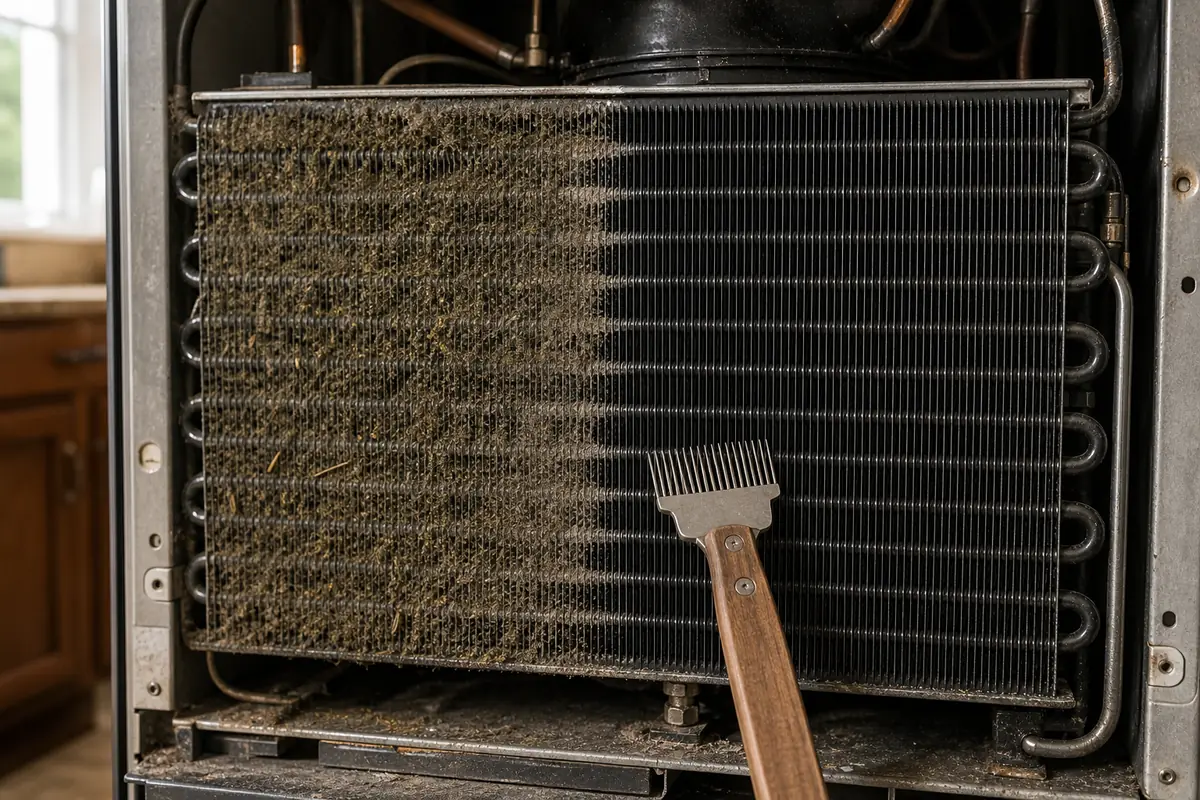
The “vacuum condenser” message appears on Sub-Zero® 600 series control boards built between 1998 and 2002 when the compressor logs excessive run time. In our Ortega experience, nine cases out of ten trace to a dust-blanketed condenser coil — a $250 to $550 service — not a failing condenser.
For vintage Sub-Zero repair in Ortega, Avondale, and Riverside, call the shop at (904) 893-3248 or Book online .
(904) 893-3248 · Tue–Sat · 8:00 am–6:00 pm · you reach the bench, not a call center
What the board is actually measuring
The vacuum condenser warning is a run-time alarm: the control board counts how long the compressor works to hold set point, and when that count goes past its programmed threshold, it concludes the condenser must be choked and tells you to clean it. The board cannot see dust — it infers dust from effort.
That inference is usually right. A condenser buried in lint sheds heat poorly, so the compressor labors longer for the same cold. But the same excessive run time can come from a weak fan motor, a thermistor reporting fiction, or a refrigerant charge slipping away — which is why a light that returns after cleaning deserves respect, not another pass with the brush.
Why only the 1998–2002 boards say it
Sub-Zero built the 600 series from 1996 to 2009 across three electronic generations — the trade calls them 600-1, 600-2, and 600-3, with the first generation ending near serial number 1810000. The “vacuum condenser” wording belongs to the boards of roughly 1998 to 2002; later logic expresses the same complaint through different service indications, and the mechanical-control 500 series says nothing at all — it just runs.
The same era is a minefield of part revisions. A board that fits a 632 side-by-side may not serve a 650 or 661, and several versions now exist only as rebuilt exchanges. It is the central reason we test before we replace — detail covered in our 600 series repair notes.
| How the light behaves | What that suggests | Sensible next step |
|---|---|---|
| Appears after months of quiet running | Coil overdue for cleaning | Condenser service, $250–$550 |
| Returns within weeks of a thorough cleaning | Fan motor, thermistor drift, or gasket leak | Bench diagnosis, $550–$1,100 lane |
| Shows alongside warming compartments | Possible refrigerant loss | Frost-pattern check before gauges |
| Display shows double dashes instead | Board EEPROM failure, not the condenser | Board exchange where stock allows |
Which board generation is talking to you
The 600 series ran across three control-board generations, and the wording on the panel is a rough date stamp. The first generation ends near serial number 1810000; the “vacuum condenser” phrase belongs to the run that followed it. Match the plate inside your fresh-food door to the table before assuming any part is the culprit.
| Generation | Rough years | How the condenser complaint shows |
|---|---|---|
| 600-1 (before serial ~1810000) | 1996–1998 | Earliest logic; service light rather than the named phrase |
| 600-2 | 1998–2002 | The literal “vacuum condenser” run-time message |
| 600-3 | 2002–2009 | Same condition, expressed through later service indications |
This matters because a board that fits a 632 side-by-side may not serve a 650 over-under or a 661 bottom-mount, and several versions now exist only as rebuilt exchanges. The full series breakdown sits on our 600 series repair notes.
Clearing the warning the careful way
- Disconnect power at the breaker or the unit’s switch.
- Open the top grille — on a 600 series the condenser lives up high, which is why it inhales kitchen dust so efficiently.
- Vacuum the coil face, then brush between the fins gently and vacuum again. Bent fins block air as surely as lint does.
- Restore power and give the machine a full 24 hours to stabilize at 38°F and 0°F before judging the result.
- If the light returns inside a month, stop cleaning and start diagnosing — the coil is now an alibi.
In the houses we serve around the Shoppes of Avondale and along the Ortega riverfront, the oak canopy and resident dogs make a quarterly coil check realistic rather than fussy. Sub-Zero’s own guidance calls for cleaning every six to twelve months under ordinary conditions — ours are not ordinary.
When the light points past the coil
The Avondale and Riverside kitchens remodeled in the nineties carry these boards in numbers, and at twenty-five years old the supporting cast wears out too. A fan motor with dry bearings imitates a dirty coil perfectly. A thermistor drifting a few degrees makes the board chase phantom warmth. A gasket softened by river humidity leaks moist air the compressor must fight all day — the fix there is plain door gasket replacement, not electronics.
And occasionally the run time is honest: the charge is leaking. That verdict comes from the evaporator frost pattern, never guesswork, and moves the conversation to sealed-system territory — where we quote firm and explain the constant-running arithmetic before a single fitting is opened.
Run-time warning or dead board: telling them apart
Owners often conflate two different 600 series faults. The vacuum condenser message is a behavioral warning — the board still works and is reporting effort. Double dashes where the temperature should read are a different animal: the board’s EEPROM memory has failed, and no amount of coil cleaning touches it.
| What the display shows | What it actually means | The fix lane |
|---|---|---|
| “Vacuum condenser” message, temps readable | Run-time alarm; board healthy, condenser suspect | $250–$550 coil and airflow service |
| Double dashes instead of a temperature | EEPROM failure; the board itself is gone | $550–$1,100 board exchange, stock permitting |
| Blank panel after a storm, lights dead | Restoration-surge damage to the board or supply | $550–$1,100 once the part is confirmed |
A surge-killed board is the most common version we pull from Avondale and Riverside kitchens after a stormy week — the same pattern behind a unit that runs without ever shutting off. When the board is truly gone, the repair-or-replace arithmetic turns on whether a compatible exchange board still exists.
Owners ask about the warning
Does the vacuum condenser light mean the condenser has failed?
Almost never. The board is reporting that the compressor has been running longer than its programming expects, and a fouled condenser coil is the most common reason. The coil itself is rarely the broken part — it is simply buried under dust, pollen, and pet hair. A proper cleaning clears the warning in most homes we visit.
Why does the warning return a few weeks after I clean the coil?
A quick return visit from the light means the excessive run time has another driver: a condenser fan motor losing its bearings, a thermistor reporting the wrong temperature, a gasket leaking humid air into the box, or — least welcome — a slow refrigerant leak. At that point the coil is an alibi, and the unit has earned a bench diagnosis.
Which Sub-Zero models can show the vacuum condenser message?
You will see it on 600 series machines — 632, 642, 650, 661 and their siblings — carrying the control boards built from roughly 1998 to 2002. Earlier 500 series units use mechanical controls and stay silent; later electronic generations report the same condition through different service indications. The model and serial plate settles which board you have.
Is it safe to keep groceries in the unit while the light is on?
Usually, in the short term. The warning is preventive — temperatures are typically still holding when it first appears. Check the compartments against 38 and 0 degrees; if they read true, you have time to schedule rather than scramble. If either side is drifting warm, move the perishables and call, because the machine is now losing the fight.
How do I clear or reset the vacuum condenser message after cleaning the coil?
On most 1998–2002 boards the message clears on its own once the compressor logs a normal run cycle against a clean coil — give it a full 24 hours to settle at 38 and 0 degrees first. Some generations want a power cycle at the breaker to reset the run-time counter. We confirm the right procedure for your exact board, because forcing a reset on a unit that is still struggling only hides the symptom.
Can I keep using the unit if I just ignore the vacuum condenser light?
For a short stretch, yes, but it is a false economy. The warning exists because long run times overheat the compressor oil and wear the valves; left blanketed for a season, a $250 to $550 coil cleaning can mature into a $1,000 to $2,000 compressor. The light is the cheap warning the board gives you on purpose — clearing the coil while it is still only a warning is the whole point.
Does the vacuum condenser warning ever appear on a clean, recently serviced unit?
It does, and that is the useful case. A warning on a coil you know is clean removes the obvious suspect and points at run-time drivers underneath: a condenser fan losing its bearings, a thermistor reading a few degrees off, a gasket leaking humid river air, or a slow charge loss. At that point the unit has earned a bench diagnosis rather than another pass with the vacuum.
Bring us the machine everyone else gave up on.
The shop answers Tuesday through Saturday, eight to six. One visit, a straight diagnosis, and a firm number before any work begins.