Repair services · ice
Sub-Zero Ice Maker Repair in Ortega and Avondale
Around here, ice makers rarely die of old age. They die of minerals — slowly, and right on schedule.
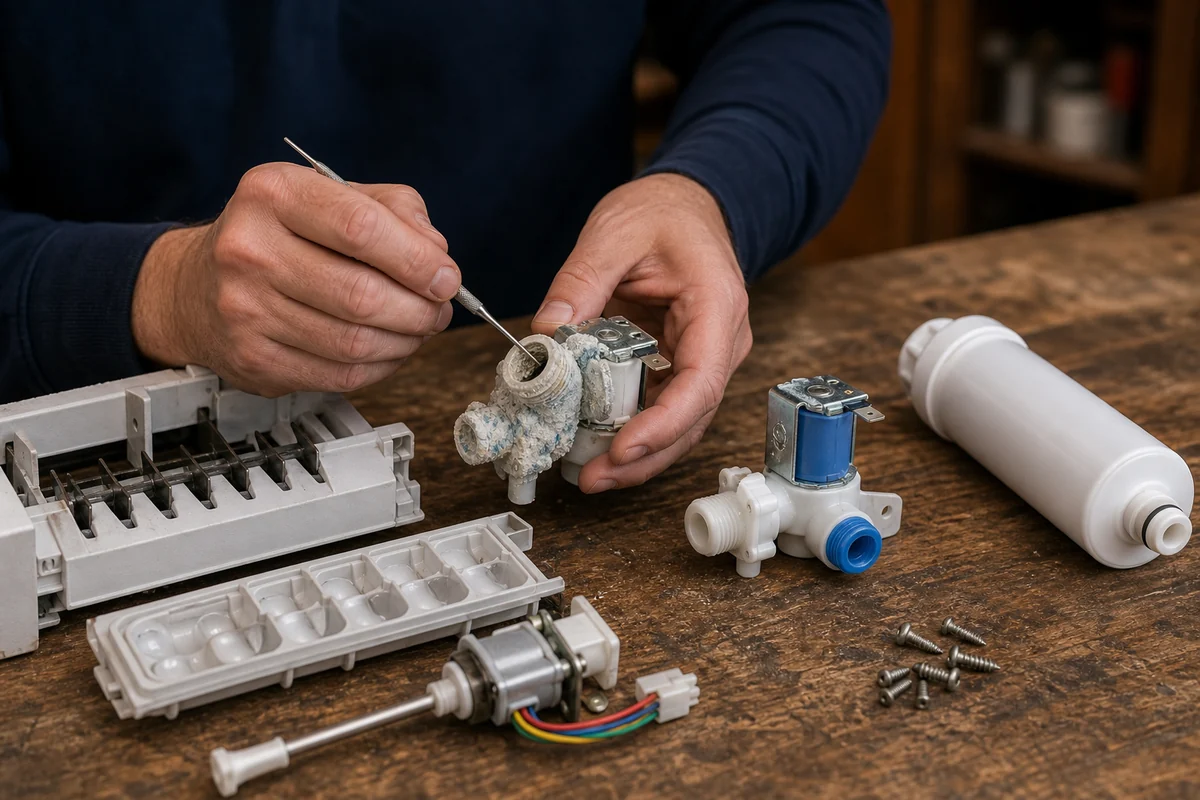
Jacksonville water measures 14 to 28 grains per gallon — hard enough to crust a Sub-Zero® fill valve with scale in a few seasons. Our Ortega bench descales, rebuilds, and replaces ice maker assemblies across Avondale and Riverside, with most jobs falling between $250 and $1,100.
For vintage Sub-Zero repair in Ortega, Avondale, and Riverside, call the shop at (904) 893-3248 or Book online .
Sub-Zero Repair Ortega takes ice maker calls for the 32210 and 32205 ZIPs at (904) 893-3248, Tuesday through Saturday — or use the online booking page and we will confirm a window by phone.
Updated June 13, 2026.
(904) 893-3248 · Tue–Sat · 8:00 am–6:00 pm · you reach the bench, not a call center
Why is hard water the first suspect in Jacksonville?
The water that feeds every kitchen from Ortega Forest to Riverside is drawn out of limestone, and it shows: 14 to 28 grains per gallon puts this metro firmly in the “very hard” column, among the hardest in Florida. Every fill cycle leaves a little of that mineral load behind — on the valve screen, in the fill tube, on the mold where the cubes form.
The valve suffers most. Its orifice is small by design, so a thin crust of scale changes everything: cubes come out undersized, then hollow, then not at all. In older houses near the river, original-era supply plumbing adds its own sediment to the mix. None of this is a design flaw — it is simply what this water does, and a bench that works on it weekly plans for it.
| The complaint | Where we look first | Likely ticket |
|---|---|---|
| Cubes shrinking week by week | Scale on the fill valve screen | $250–$550 |
| No ice at all, unit cooling fine | Valve solenoid, then the ice maker module | $550–$1,100 |
| Ice tastes musty or stale | Bin condition, water filter, slow turnover | $250–$550 |
| Water pooling under the bin | Fill tube alignment and inlet valve seal | $250–$550 |
The vintage ice makers we rebuild
The 500-series machines carry ice makers simple enough to rebuild piece by piece, and we do. The 600 series added electronics with a known quirk: a fault that trips when the fill solenoid stays energized past fifteen seconds — the kind of detail covered at length in our 600 series bench guide. Later BI-era built-ins mostly wear out their water inlet valve solenoids, a clean and predictable replacement.
One caution from experience: an ice maker that quits at the same time the compartment loses temperature is not an ice maker problem. If the box itself is warming, start with a proper refrigerator diagnosis before spending anything on the ice side.
Avondale’s remodel generation comes due
The blocks around the Shoppes of Avondale went through a wave of kitchen remodels in the nineties and early two-thousands, and the 600 series units installed then are now two decades into the same hard water. Most weeks our ice maker calls cluster there and along the riverfront, where summer storm-season power flickers add board trouble to the mineral trouble.
We keep the common valves and solenoids stocked for exactly that reason. If your kitchen sits on those streets, our Avondale rounds probably already pass your door — and a same-week slot is the usual outcome of a Tuesday call.
What an ice maker visit actually covers
An ice complaint is rarely one thing, so the visit follows a fixed order rather than a parts-cannon. Here is how an Ortega call runs from the doorbell to the first good batch.
- Confirm the freezer is cold. The mold cannot harvest unless the compartment holds 0°F, so the thermometer comes out before any ice part is touched.
- Check water in. We measure flow at the fill valve and inspect the inlet screen for the scale this 14-to-28-grain water leaves behind.
- Test the electrics. Solenoid resistance, module motor, and the harvest thermostat each get a reading rather than a guess.
- Descale and clear. The fill tube, valve screen, and mold are flushed of mineral buildup — often the entire fix on an early call.
- Run and verify. We cycle the maker, send the first batches to waste, and confirm full-size, clear cubes before packing up.
The ice-maker parts hard water wears out first
Scale does its damage in a predictable sequence, and so does the parts list. These are the components we replace most on Ortega and Avondale ice makers, and why each gives out.
| Part | What hard water does to it | Repair lane |
|---|---|---|
| Water inlet (fill) valve | Scale narrows the orifice, then jams the solenoid | $250–$550 |
| Fill tube | Mineral crust restricts flow or freezes shut | $250–$550 |
| Ice maker module / motor | Burns out cycling against a blocked valve | $550–$1,100 |
| Water filter (where fitted) | Loads fast and passes off-taste minerals through | $250–$550 |
A 600 series maker that throws a fault when the fill solenoid stays energized past fifteen seconds is a special case — that electronic quirk is covered in the 600 series bench file, and the sealed-system page handles the rare instance where weak freezing, not the maker, is the real fault.
Ice questions, answered plainly
Why did my Sub-Zero ice maker slow down before it stopped?
That slow fade is the signature of scale. Minerals close the fill valve’s orifice a little at a time, so cubes shrink, then turn hollow, then stop arriving at all. Caught at the shrinking stage, a descale and valve service is a modest job; ignored, it can burn out the solenoid working against the blockage.
Can descaling alone bring an ice maker back?
When the trouble is caught early, often yes — clearing the valve screen and fill path restores normal water flow and full-size cubes. If the solenoid has already overheated or the module’s motor is worn, parts are the honest answer. We test each component rather than guess, and we tell you which case yours is.
Why does the ice taste musty or stale?
Usually the bin, not the machine. Ice absorbs odors from the freezer, an aging water filter contributes its own off notes, and slow household turnover lets cubes sit for weeks. We clean the bin, fit a fresh filter where the unit takes one, and run the first batches to waste before calling it done.
Is it smarter to replace the whole ice maker assembly or just the valve?
If the mechanism itself tests healthy, a valve is the right-size repair. When the module motor, ejector, or thermostat shows wear, the full assembly earns its cost — on vintage units the deciding factor is often which parts are still obtainable. When both paths are sane we quote both and let you choose.
How often should an ice maker be descaled on Jacksonville water?
In this 14-to-28-grain water, once a year is realistic, against the every-few-years interval the manual assumes for soft water. We descale the fill path, clear the valve screen, and flush the mold during the visit. Owners on original-era plumbing near the river often run sediment as well as scale, so we check the supply line at the same time.
Why is the ice maker leaking water onto the freezer floor?
Usually a misaligned fill tube or a fill valve that no longer seats fully — both let water dribble past the mold instead of into it. On older units a cracked fill cup or a frozen fill tube can do the same. We trace where the water actually lands, realign or reseat the part, and confirm the inlet valve closes clean before refilling.
Can a clogged condenser stop an ice maker from making ice?
Indirectly, yes. If the condenser is choked and the freezer cannot hold 0°F, the ice maker mold never reaches the harvest temperature it needs, so cubes form slowly or not at all. That is why we read the freezer temperature before condemning any ice-side part — a $250 to $550 coil cleaning sometimes restores the ice on its own.
Bring us the machine everyone else gave up on.
The shop answers Tuesday through Saturday, eight to six. One visit, a straight diagnosis, and a firm number before any work begins.